


Vědecké zaměření Oddělení kosmické chemie a techniky
Exploring the space chemistry, in particular chemical evolution/habitability of ice moons and developing technologies to support future missions.
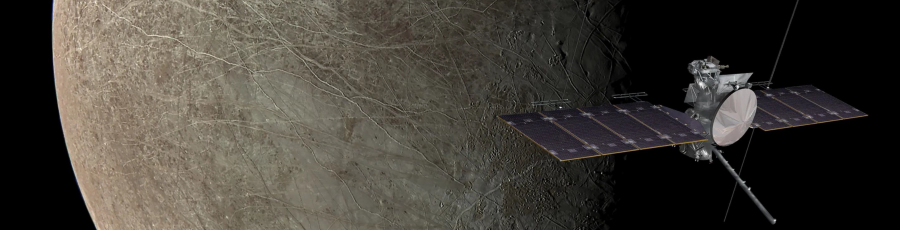
Europa Clipper mission to Europa (Source: NASA/JPL 2025).
The Department of Space Chemistry and Technology at the J. Heyrovský Institute of Physical Chemistry (HIPC) advances the frontiers of space science by combining fundamental chemistry, cutting-edge instrumentation, and mission-driven research. Established in 2025 under the prestigious ERA Chair initiative and led by Prof. Dr. Bernd Abel, our department positions the Czech Republic and HIPC as leaders in astrochemistry and advanced space-analytical technologies.

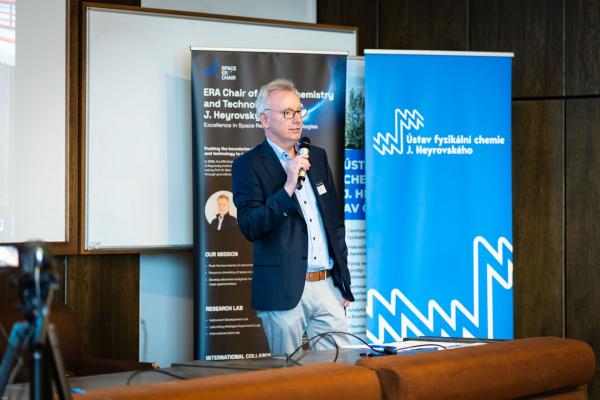
B. Abel, Source: HIPC 2025
We investigate how matter behaves in extreme space environments such as ice moons, how chemical and biochemical evolution can emerge in extreme environments, and how to build instruments capable of detecting habitability, life and its chemical signatures in space. Our work aims to directly support major international space missions, including NASA's Europa Clipper.
Through international collaboration, pioneering analogue laboratory experiments, and development of compact high-resolution mass spectrometry systems for spaceflight, we are pushing the boundaries of space exploration and preparing for humanity's next great scientific milestones.
Our Mission
Our mission is to push the boundaries of astrochemistry and space technologies by:
- Investigating the chemistry of extreme space environments
- Developing and validating novel miniature instruments for spacecraft and CubeSats
- Designing laboratory simulations of planetary and icy-moon conditions
- Studying processes relevant to the origins of life and the evolution of organic matter in space
- Building AI-ready mass spectrometry databases to rapidly interpret space mission data
- Collaborating with leading global partners including ESA, NASA, and ELI Beamlines
We merge fundamental chemistry with space engineering and astrobiology, driving scientific excellence and technological innovation in Europe's rapidly growing space research landscape.
Research Directions
1. Enceladus and the Cassini mission
Although the Canini mission has come to an end, a large number of data remain to be analyzed. We support the analysis of the data though advanced laboratory analogue experiments, e.g. with compact ice accelerators (SELINA).
2. Europa & the Europa Clipper Mission
Europa, an icy moon of Jupiter, is one of the most promising locations in our Solar System to search for extraterrestrial life. The department helps supporting the SUDA (Surface Dust Analyzer) instrument aboard NASA's Europa Clipper, which will analyze ice particles ejected from Europa's surface, with analogue experiments and databases.
Our research addresses critical scientific questions:
- Optimizing SUDA's performance through realistic laboratory simulations
- Identifying and prioritizing biosignatures and chemical markers of habitability
- Determining how ice particle impacts and high-velocity collisions affect molecular fragmentation and ionization
- Comparing laboratory-generated Europa ice analogues with other analogue experiments
- Developing an AI-compatible spectral database to interpret SUDA data during the mission
These efforts help ensure that the international scientific community can accurately interpret SUDA measurements and assess the habitability of Europa's subsurface ocean.
Why it matters
Understanding how organic molecules behave under Europa-like conditions is essential to demonstrating whether signs of life - if they exist - can be detected with confidence. Our laboratory validation and models will directly support the dedicated habitablity detection-type experiment at an icy moon.
3. ORACLE CubeSat Mission - high resolution mass spectrometry and composition analysis from Low Earth Orbit
To explore space dust, micro- and nano meteoroids, and anthropogenic particles entering or emerging from Earth's atmosphere, we are developing a high resolution mass sensor for ORACLE, a proposed CubeSat-class mission, which is planned to be led by the Heyrovský Institute and the Space Chemistry and Technology Department.
ORACLE features:
- HANKA - a high-resolution space mass spectrometer for nano- and micro-particle analysis
- Optical/UV video and hyperspectral imaging to detect and characterize larger objects
- Real-time monitoring of cosmic dust, meteoroids, and space debris
- Chemical analysis of extraterrestrial organics and in-orbit pollutants
By uniting chemical sensing with optical tracking, ORACLE bridges gaps between astrophysics, environmental monitoring, and space sustainability. It complements flagship missions and provides continuous data - something currently not available from large satellite platforms.
Scientific and societal impact
- Tracks interplanetary and artificial particle flux
- Advances research into origins of life and cosmic material transport
- Helps characterize space debris chemistry and atmospheric pollution risks
- Provides early-stage technology demonstration for future planetary missions
This mission positions HIPC as a European innovator in space-borne mass spectrometry and CubeSat science.
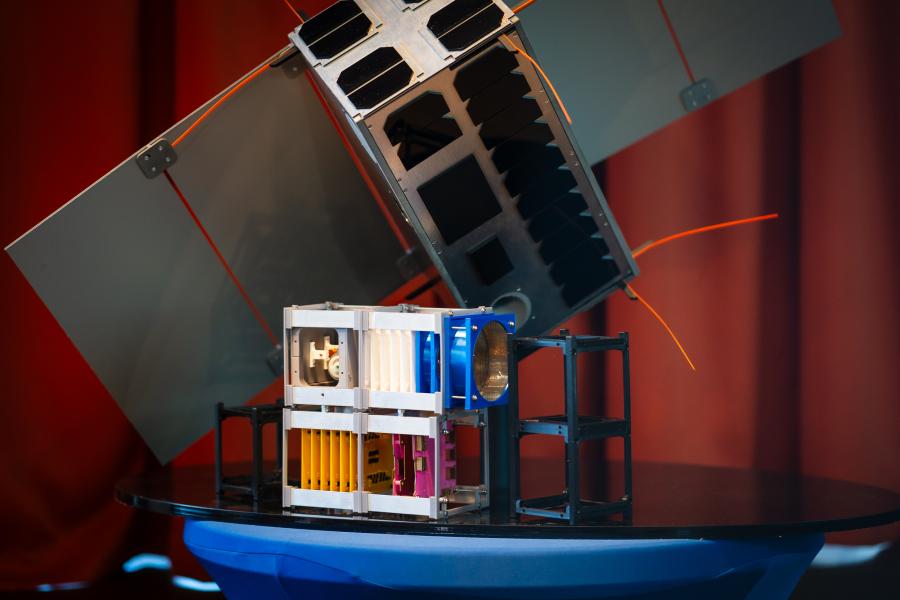
HANKA instrument model in cubesat format (Source: HIPC).
4. Radiation-Driven Chemistry in Icy Worlds (ELI Collaboration)
Europa and other icy moons are constantly bombarded by high-energy radiation. To reproduce these extreme environments, we collaborate with the Extreme Light Infrastructure (ELI) in Prague, one of the world's most advanced laser and particle-beam centers.
Our experiments simulate:
- Europa's electron radiation environment (tens of MeV electron beams)
- Irradiation of ice analogues, nanoparticles, and comet-like materials
- Prebiotic chemical reaction pathways triggered by radiation
We study how radiation:
- Alters molecular structures in ice
- Produces reactive precursors of biologically relevant molecules
- Drives chemistry relevant to life-origin scenarios on icy worlds
These laboratory simulations support interpretation of Europa Clipper measurements and help determine whether radiation could create or preserve biosignatures in surface ice.
Why Our Research Matters
The Department of Space Chemistry and Technology stands at the interface of planetary science, analytical chemistry, and space engineering. Our work enables:
- Reliable detection of life-related molecules in space and on ice worlds
- New miniature analytical instruments for spacecraft and CubeSats
- Real-time chemical sensing in orbit - a new paradigm in space research
- Fundamental knowledge about the chemistry of the Solar System
- Cross-disciplinary collaboration spanning chemistry, physics, astrobiology, machine learning, and aerospace engineering
By combining experimental innovation, mission development, and international partnerships, we are shaping the future of European space science.
Our Vision
We aim to become a global leader in:
- Astrochemistry and planetary environment simulations
- Space mass spectrometry and compact analytical instruments
- Laboratory support for life-detection missions
- CubeSat-based scientific missions in Earth orbit
- AI-powered analysis of space chemical data
Our department builds knowledge and technologies that will help answer one of humanity's greatest questions, namely „Are there other places in space beyond earth that display unambiguous signs of habitability and biosignatures?".
Photo Gallery:
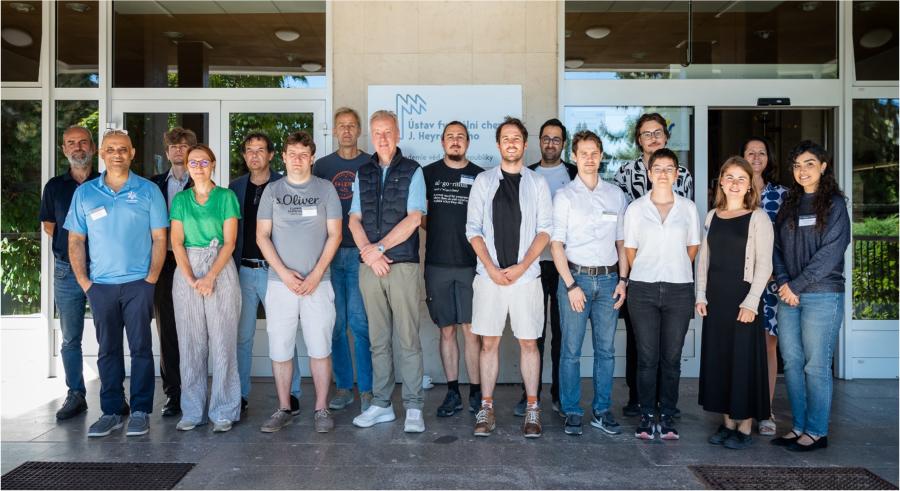
Members of the Department during a Summerschool on Space Chemistry and Technology in September 2025 at the Heyrovsky Institute together with external and internal collaboration partners (Source: HIPC).
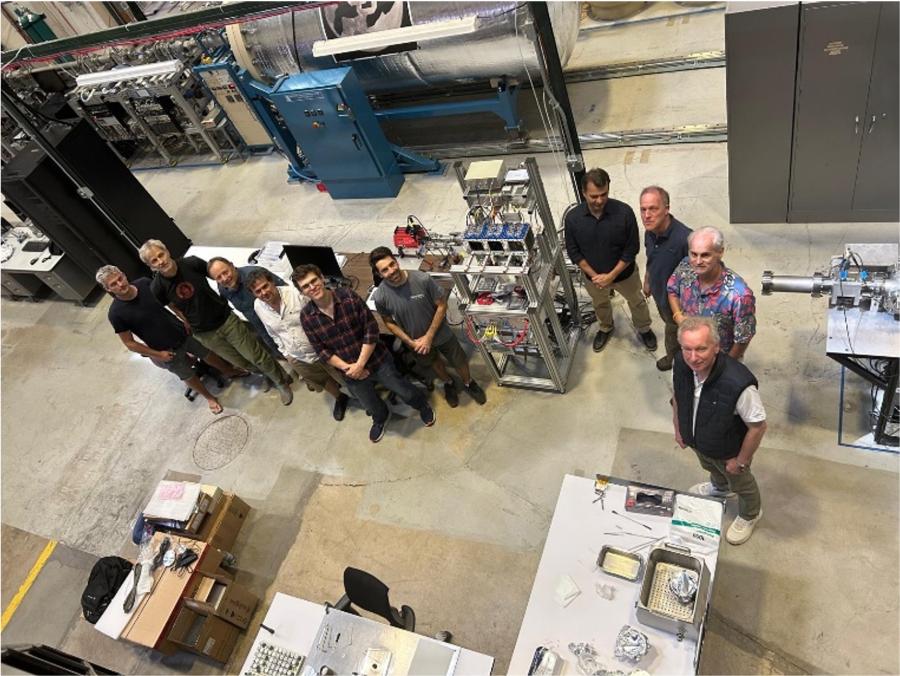
SELINA setup at Dust Accelerator Laboratory (DAL@LASP) in Boulder, CO. From left to right: Jordy Bouwman, Aleš Charvát, Mihály Horányi, Ján Žabka, Marshall Seaton, John Fontanese, Zoltan Sternovsky, Tobin Munsat, Sascha Kempf, Bernd Abel. Photo: J. Heyrovský Institute of Physical Chemistry (Source: HIPC).